Trusted by Institutions Globally

As work changes, people need a place to practise.

New tools and changing roles put pressure on the people responsible for training. A course can explain a task, but participants also need opportunities to try it and learn from their decisions.

We build custom training games and simulations for ministry-led public programmes and government teams. Participants work through realistic situations, with practice shaped around the skills the programme needs to develop.

Ministry-led programmes for the public

Prepare people for employment and support the skills needed in priority sectors. Build practical experiences into the programmes a ministry funds or delivers.

  • Workforce development and career transitions
  • AI literacy and practical digital skills
  • Training for tourism, industry and other priority sectors

Training for government employees

Give teams a place to rehearse the work behind public services. Shape scenarios around the procedures they follow and the people they support.

  • Onboarding and applying new procedures
  • Citizen service and difficult conversations
  • Responsible AI use and cybersecurity

The scale of the skills challenge

Global projections and employer findings for 2025–2030. Source: World Economic Forum, 2025

170 million

170 million

New jobs projected globally by 2030.

92 million

92 million

Existing jobs projected to be displaced globally by 2030.

39%

39%

Of existing skills expected to change or become outdated from 2025 to 2030.

59%

59%

Of workers expected to need training by 2030.

63%

63%

Of surveyed employers identify skills gaps as a major barrier to transformation.

85%

85%

Of surveyed employers plan to prioritise upskilling their workforce.

See what simulation-based training looks like.

Work through an audit or practise a difficult conversation. These examples show how we can turn the decisions people face at work into practical training.

An audit simulation showing a client file, financial signals and the controls claim learners need to test.

Audit & assurance

Take on an audit engagement.

Management says its controls are effective. Review the records, test that claim and explain your conclusion to the audit partner.

One Click Away: a simulated workplace chat and inbox where employees make security decisions.

Cybersecurity awareness

Make the call on a suspicious request.

Navigate a new hire's inbox under pressure. Decisions about suspicious links and password requests shape what happens next.

Counterpart: a customer across a meeting table challenges a renewal proposal.

AI negotiation

Practise a difficult conversation.

Speak with an AI customer who responds to what you say. Work through a difficult conversation, then get feedback on your approach.

Frontline: a guest approaches the hotel front desk while the player practices greeting and eye contact.

Front desk training

Step into a service role.

Step behind a hotel front desk and work through a guest's arrival. Practice the welcome and booking checks while using the hotel's systems.

Operator Rounds: an operator in a control shack with radio and notebook tools ready for an inspection.

On-site SOP training

Work through an operational problem.

Take a field operator's shift. Inspect equipment and use your radio and notebook to build a clear account of an abnormal condition.

The Desk: a banking investigation workspace with a customer terminal, case file, and transaction records.

Financial crime investigation

Follow the evidence in an investigation.

Investigate a flagged transaction using customer records and case evidence, then put your decision into writing.

Have a different training need? We can build a simulation around it.

We build custom training around your priorities.

Bring an existing course, a procedure or a skill people need to develop. We work with your subject experts to turn it into a game or simulation, with scenarios and feedback shaped around your programme.

Discuss a custom simulation

Adapt an existing experience

Use a relevant example as the starting point, then adapt its situations and learning goals for the people taking part.

Build a new experience together

Create the scenario around a specific role, public programme or training challenge. Your team helps define what good performance looks like.

Language, accessibility, delivery format and reporting needs are agreed as part of the build.

Practice for participants.
Useful evidence for programme leaders.

Design the training around what people need to do, then agree how their progress will be reviewed.

  1. Rehearse before it matters

    Practise a conversation, procedure or unfamiliar task in a simulation before handling the situation at work.

  2. Give people a reason to take part

    A task to complete and consequences to explore make participants active in the experience. Feedback gives them a reason to try again.

  3. See where support is needed

    Agree which decisions and explanations the simulation should capture so trainers can review mistakes and plan follow-up practice.

  4. Build on each cohort's experience

    Pilot the training with one group. Use their feedback and the agreed measures to refine it before extending delivery.

Help people use AI with sound judgement.

AI skills start with understanding what a tool is doing and knowing when to question its output. We build practical training for government teams and AI literacy programmes for school and university students.

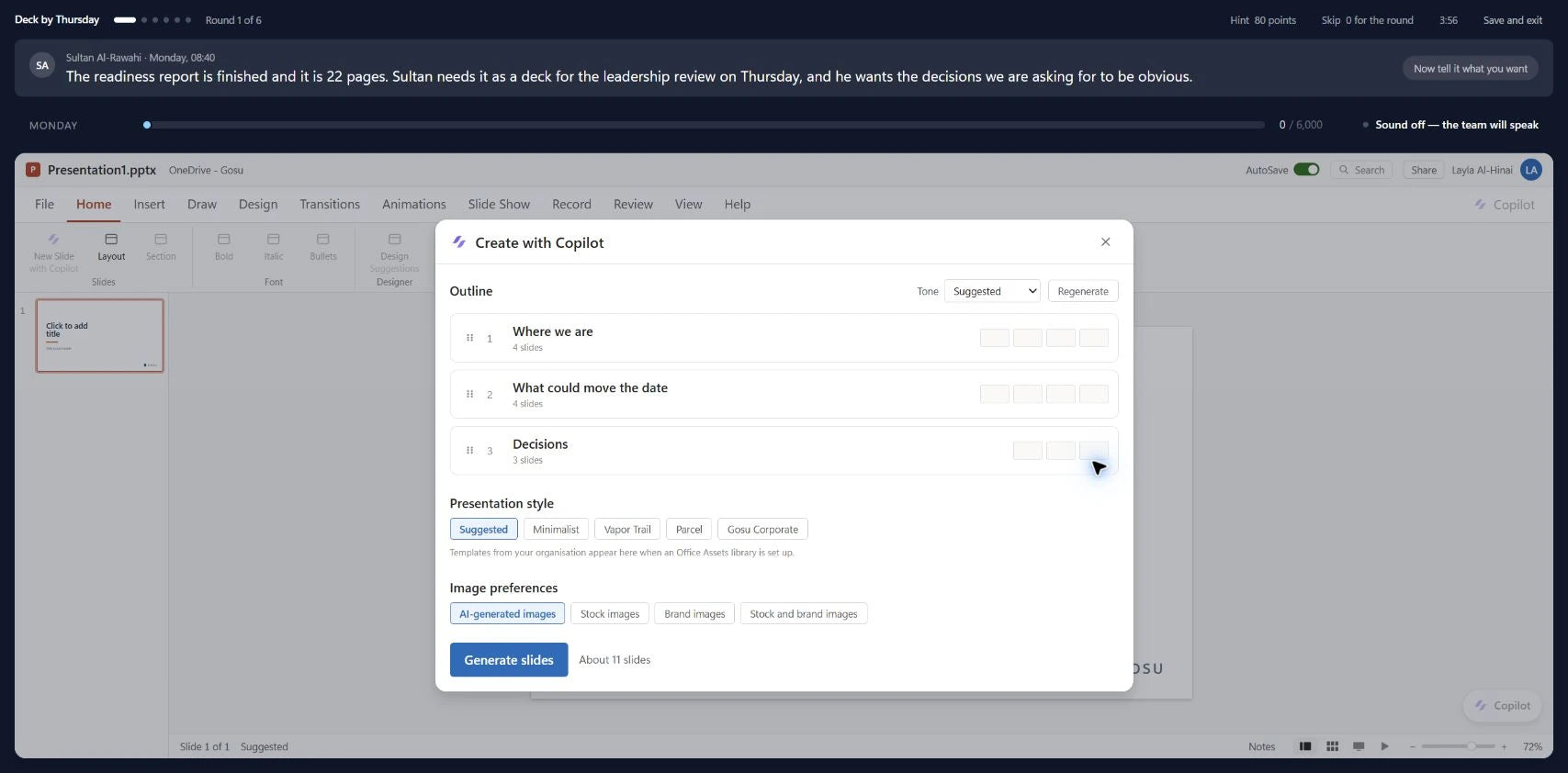
Create with Copilot presentation outline inside the simulated PowerPoint workspace.

Copilot for everyday work

In Deck by Thursday, learners build a presentation from a report. They choose how to use Copilot and review its work before moving on.

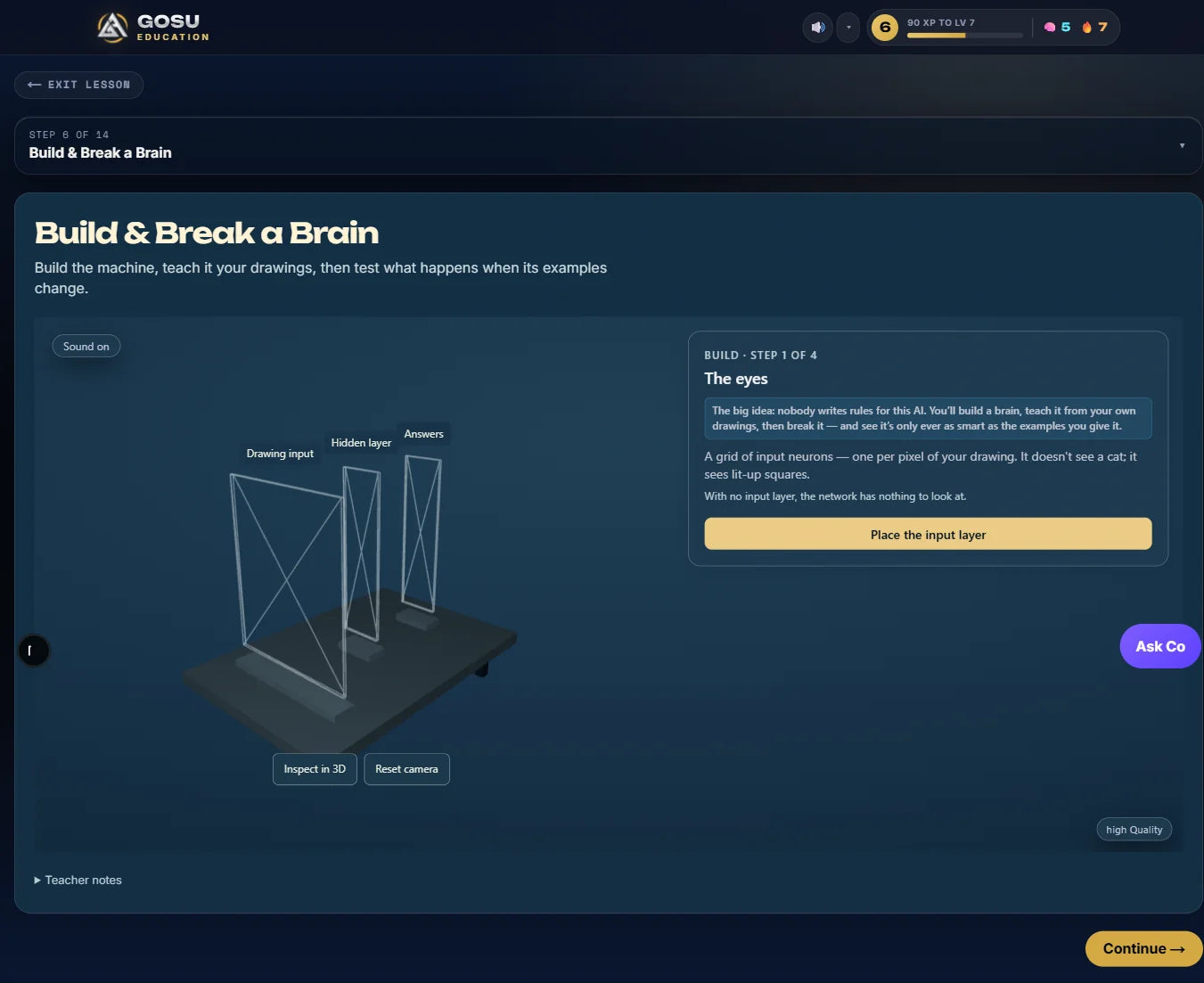
Build and Break a Brain in Gosu Education, with a three-dimensional neural network activity and guided lesson steps.

AI literacy for students

Our programme helps school and university students explore how AI learns and where it can go wrong. In this demo, they build a small neural network and test how changing its examples changes the result.

Inside the simulation

Try the demo

Explore a training demo

Enter your name and email to get started. We'll remember this browser for 30 days so you can try the other demos.

We'll email you about this demo and Gosu Academy's training programmes. You can opt out at any time. Privacy policy

Saudi Ministry of Communications and Information Technology Helping faculty bring AI into their teaching.

Working with Saudi Arabia's Ministry of Communications and Information Technology and national universities, Gosu Academy delivered an AI in Gaming faculty programme. Participants explored generative AI and game engines with practitioners and researchers, then developed plans for using what they had learned in their own academic programmes.

  • 32 professors certified
  • 18 universities represented
  • 600+ students per year in projected downstream reach
How it works image

Saudi Esports Federation Practical training for careers in esports .

Gosu Academy worked with the Saudi Esports Federation on career programmes in casting, coaching, event operations and content creation. Participants learned through practical activities and instruction from industry experts. Graduates went on to contribute to national events, including the Esports World Cup.

  • 351+ participants
  • 89% graduation rate
  • $5.4M potential graduate wages (upper estimate)

Process Start with a pilot

Build with your experts, try it with participants and use the findings to plan the next step.

01

Define the training need

Agree who the programme serves, the tasks they need to practise and how progress will be reviewed.

02

Design with your experts

Choose realistic situations and define the decisions, feedback and evidence the experience should include.

03

Build and review

Try the experience as it develops. Review the content and controls alongside the agreed delivery requirements.

04

Prepare and run the pilot

Introduce facilitators to the experience and run it with an initial group of participants.

05

Review and plan expansion

Use participant feedback and the agreed measures to improve the training before extending the programme.

Meet With Our Experts

More ways we support public programmes.

Alongside custom simulations, we can support the people delivering a programme and the wider learning experience.

Trainer development

Help instructors build their knowledge of AI and game-based learning, and prepare them to deliver the activities.

Programme delivery

Discuss instructor-led sessions and practical activities that support a wider workforce or education initiative.

Gaming and esports pathways

Develop training around careers in gaming and esports, drawing on our experience delivering sector programmes.

Explore esports programmes

Practical questions

Can you build training for the public as well as government employees?

Yes. We can build for ministry-led workforce and education programmes, or for an agency's own staff. We start with the people taking part and the tasks they need to practise.

Can we use an existing course or procedure?

Yes. Your course material or procedure can provide the starting point. We work with your experts to select the situations worth practising and agree the feedback and assessment criteria.

Can we start with a pilot?

Yes. One activity and an initial cohort can provide a useful starting point. We agree the scope and success measures, review the experience together and use the findings to plan any wider rollout.

Can you build training for Copilot or other AI tools?

Yes. The Copilot demo shows one practical workplace exercise. A custom build can focus on the tools and tasks your programme covers, including how participants check outputs and follow your guidance on AI use.

What can we measure?

We agree the evidence each build should capture, such as completion, decisions, explanations and performance against a rubric. Programme teams can use this alongside trainer feedback and their own follow-up evaluation. Employment outcomes and return on investment require separate evaluation.

What about language, accessibility and our learning platform?

We review those requirements during scoping, along with available devices, sign-in, data handling and reporting. The delivery plan specifies which languages, accessibility requirements and integrations the build will support.

Do participants need gaming experience or a VR headset?

The examples on this page can be tried in a desktop web browser. For a custom build, we design the introduction and controls around the participants and the equipment available to them.