Put the pull of games to work.
Give students a challenge worth investigating. In a learning game, each choice changes something they can see, and feedback gives them a reason to adjust their thinking and try again.

We build learning games around your curriculum, with AI guidance for students and tools that make teaching easier.
Trusted by Partners Globally


A student can hand in a correct answer and still struggle to explain it. As AI becomes part of everyday life, schools have a harder job: helping learners think for themselves and use what they know.
That makes education more important. It also calls for learning experiences where students have to make a prediction, test an idea and explain what happened.
Give students a challenge worth investigating. In a learning game, each choice changes something they can see, and feedback gives them a reason to adjust their thinking and try again.
When a student gets stuck, a tutor can offer a hint or another explanation. We can build guidance and practice around their level of understanding, with the lesson goals set by educators.
Schools that begin testing now give their teachers time to learn what works. Waiting for the technology to settle means postponing that learning. A focused pilot helps your school build the experience to lead the change.
Plan a classroom pilot
Gamified learning boosts retention by up to 34% and engagement by 48%

In coding courses, gamification raised grades by 15% and doubled completions

88% of teachers say game-based learning increases student engagement

Shared challenges give students a reason to discuss ideas, explain their thinking and solve problems together.
Explore a few examples of what we're building. Each uses a different approach to bring a learning objective to life. Your curriculum can be the starting point for the next one.
An equation becomes a balance students can change. Remove a weight from one side and the beam tips. Apply the same operation to both sides and they see why the equality holds.
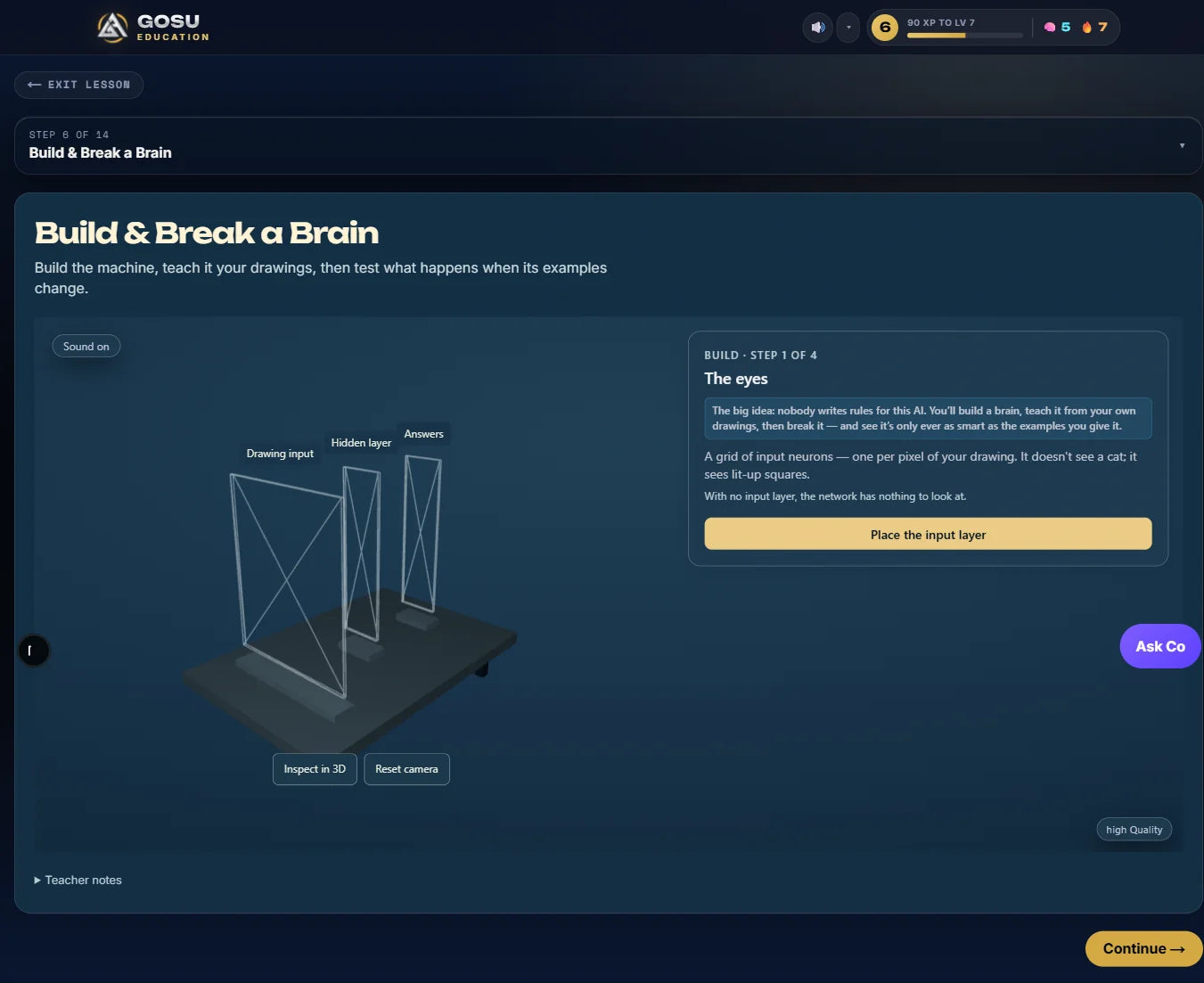
Students investigate how AI learns and where it can go wrong. They build a small neural network, test the examples behind a prediction and explore how changing the data changes the result.
Students predict how a cart will move, change the conditions and compare the result with their thinking. Then they take the same ideas out of the lab and design a stopping ramp for a truck.
Students zoom from a whole cell down to single molecules and carry out each step themselves. They watch telomeres shorten with each division, open the outer membrane of a mitochondrion to set off a cell's death and steer a macrophage to clear away the remains. The demo runs in English and Arabic.
Your school can commission a new game around any part of its curriculum. Bring us a topic students struggle with or a unit you want to teach differently. We'll work with your educators to turn those learning goals into an experience students can play.
Discuss a custom experienceWe shape the subject and learning goals, language, age level and pace with your team.
Mathematics, science, languages, humanities, digital literacy, or another area of your curriculum.
Give teachers more time to help students. Our AI literacy platform brings progress and assessment into one view, and we can build these tools into a program for your school.

Automatic grading handles routine knowledge checks. Teachers can review work that needs their judgment and spend more time helping students.
See who is keeping up, where understanding is weak and which students need support, without piecing it together from separate assignments.
Give students a challenge to work towards, with visible progress and feedback that encourages another attempt.
AI guidance can offer a hint or another explanation when a student gets stuck, so they can keep learning while you support someone else.
Technology earns its place when it helps students understand. These are some of the findings behind our focus on practice and guided support.
OECD · PISA 2022
Average mathematics performance across OECD countries fell by a record 15 points between 2018 and 2022. That is a reason to examine how students learn and where they need support.
Read the OECD reportUNESCO · Guidance on generative AI
UNESCO calls for an approach that protects human agency and involves educators in the design of learning. We take that as a starting point for guidance that helps students do the thinking.
Read UNESCO's guidanceSupport for your esports programs, gaming curriculum and the teachers who deliver them.

In and Out of Class
Launch a school esports program with coaching, team development and tournament support. We help you plan the setup and give staff the tools to run it.
Give students a place to belong and a shared goal to work towards, with opportunities to practice teamwork, communication and leadership.

Game Design, Coding & Digital Skills
Help students move from playing games to creating them. Our gaming curriculum introduces coding and game design through projects they can build, test and share.
Programs can form part of your timetable or run as enrichment, with the content and challenge adapted to your students.

Give teachers hands-on experience with AI tools and gamified lessons they can use in their own classrooms. Training covers how to guide students, review progress and adapt activities to different needs.
We provide teaching materials and implementation support so faculty can put their training into practice.


From your curriculum to a game your students can learn with.

Show us the topic you want to teach differently. We will explore relevant demos and discuss where students need more support.

Choose an existing experience or a custom build. Together, we define the learning goals and what success should look like.

Agree the curriculum, age group, language and classroom setup. We build or adapt the experience with feedback from your educators.

Give faculty time to try the activities, review the teaching materials and learn how to use the student progress tools.

Bring the program into the classroom, review how students respond and refine the experience before expanding it.
Yes. The examples show different ways to teach through interaction. We can adapt an existing experience or build a new one around another subject, a specific unit or a wider curriculum.
We agree those requirements with your educators during scoping. Language, reading level, learning objectives and the depth of the challenge help shape the experience. The algebra and physics examples include English and Arabic.
These examples run in a browser. We check the intended devices and school network as part of a pilot, especially for 3D simulations, and agree the right format for your classrooms.
AI can provide help during an activity, while educators set the learning goals and guide the class. The guidance, progression and teacher reporting included in a program are agreed with your school.